
How to Choose a Decodable Book
Check one book page against the spellings your child has learned. Print In the Box for a shared reading, drawing and book-making turn.
Your child can read words such as red and lid, but a book labeled “beginner” still leaves them stuck. The label does not tell you which spellings are inside. A decodable book is made for practicing letter sounds and spellings a child has learned. Here is how to check whether one fits your child before you hand it over.
Quick answer: Ask which spellings your child has learned, then preview two full pages of the book. Look for words your child can sound out, and decide which small words you will read for them. If you would need to supply unfamiliar words throughout the pages, choose a closer match for their reading practice.
Start with their lessons
Ask the teacher or tutor, “Which spellings should my child read independently this week? Which words are we learning separately?” Write down the answer. A book's level number cannot tell you whether its words match those lessons.
For the example below, imagine a child has learned short e, i and o, the consonants in big, red, lid and pen, and x spelling /ks/. The x matters in box: one letter spells two sounds. Check whether your child has learned it rather than assuming every short word will be familiar.
Your child's list may be smaller or different. Use their actual list. You can keep reading richer picture books aloud together; this check helps you choose the text your child will work through.
Check two pages
Open to a full page of text and read it yourself. Then check the next page. Look at the spellings in every word, including short words such as a and the.
- Find words they can read. If r, e and d with short e are taught, your child can try to sound out red.
- Spot a new spelling. In box, check whether your child has learned that x spells /ks/. Knowing b and o alone does not make the whole word a match.
- Plan for little words. In the printable below, you can read a and the aloud unless your child has learned them. Your child can read in if i and n are familiar.
- Look ahead. Check the next page too. The first page may fit even when later sentences introduce new spellings.
Make a note beside the book: “Child reads red lid. I read a.” Now you know how to share the page. If you would need to supply unfamiliar words throughout both pages, choose a closer book for independent practice. You can still read this one aloud. You are checking the book's fit, not giving your child a score.
Try a tiny book
The printable gives you four short pages: A box., A big box., A red lid. and A pen in the box. Each page has an empty space where your child can draw after reading.
Before using it, check for b, g, r, d, l, p and n; short o, i and e; and x saying /ks/. You read A/a and the unless your child has already learned them. When those words are new, use this as a book you read together.
PRINT • CUT • KEEP
Your tiny book
Cut, stack and staple four small pages. Check the spellings, read each sentence and draw its picture.
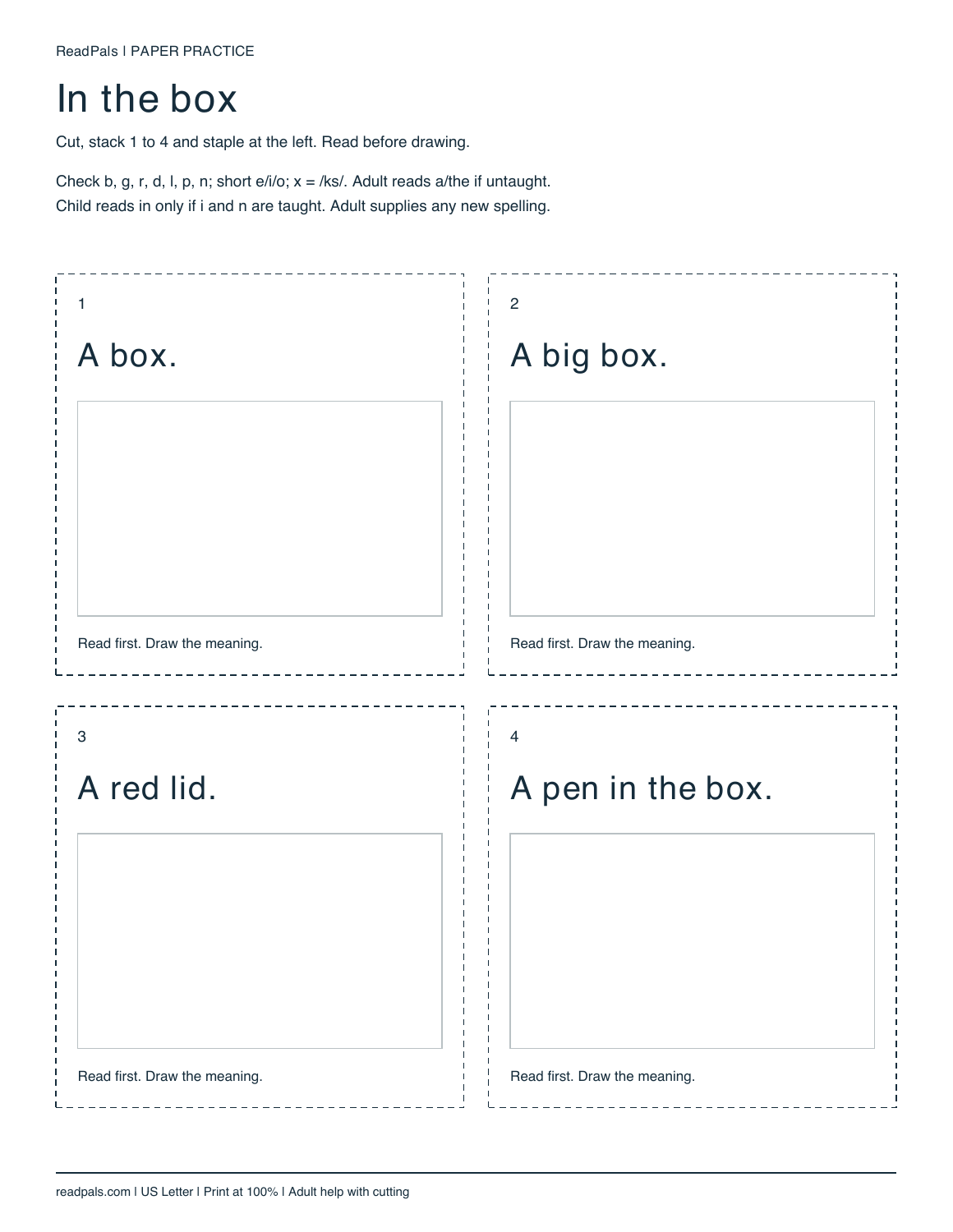
Print at 100% on US Letter paper. An adult handles cutting and any staples. No signup required.
An adult cuts out the four numbered pages, stacks them and staples the left edge. Let your child decorate the cover or add pictures in the frames. Keep staples and scissors with the adult during assembly.
If x is new, tell your child box when it appears. Invite them to read familiar words such as red and lid. Choose another text for independent practice until its spellings match their lessons.
Read, then draw
Try the third page, A red lid. Read A for your child if needed. Point to red and say, “Look at the letters. Say the sounds, then read the word.” Help with /r/ /e/ /d/ and blend them together. Do the same with lid.
Reread the sentence together: “A red lid.” Ask, “What color will your lid be?” Now your child can draw it. The picture follows the reading, so your child can show what the words meant.
One sentence and one picture can be the whole session. You can save the other pages for another evening.
Choose your help
If a spelling is new, supply the word: “I'll read this one today.” Note the spelling and ask the teacher whether it belongs in current practice.
If your child knows the spellings but has trouble joining the sounds, keep that separate from the book choice. The blending guide shows a teaching routine. Note the page and ask the teacher whether this is a book to share for now or whether another would be a closer match.
If your child is still learning individual letter sounds, read the tiny book aloud yourself. Invite them to find one letter they know. When their lessons reach blending, check again for a book they can read with you.
Try tonight: Preview two pages of one book. Mark any words you will supply. Read one matched sentence together, then let your child draw what it means. Keep the sound list beside the next book you choose.
The What Works Clearinghouse reading guide recommends teaching decoding and practicing connected text. Your child's current instruction helps you choose suitable spellings.
ReadPals offers short phonics games alongside book practice. This page check works with any reading program or library book.