How a Word Enters the Dictionary
See how dictionary editors collect real examples, weigh evidence, and turn public usage into an entry without deciding which words are real.
How a Word Enters the Dictionary
Editors follow real usage before they write an entry.
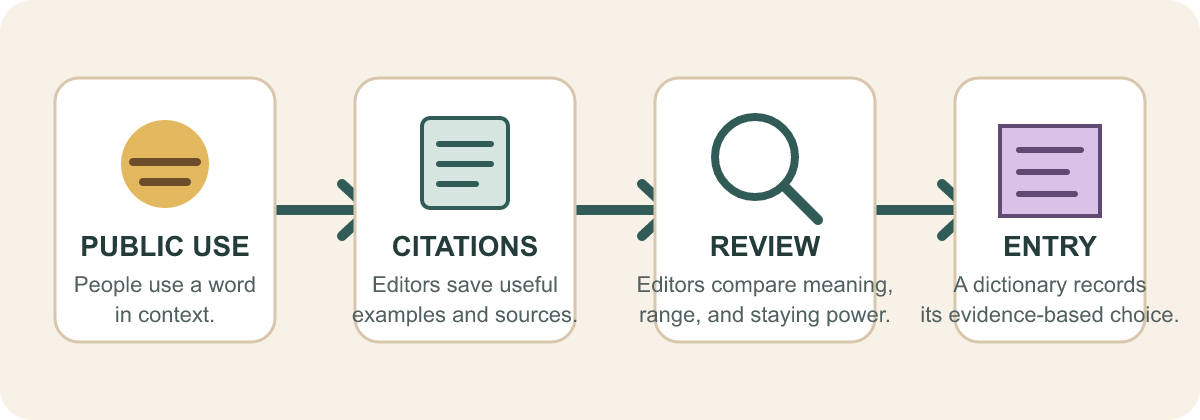
When a child asks whether a made-up word is real, a dictionary can seem like the judge. It is closer to a careful record keeper. Dictionary editors, called lexicographers, watch how people use words, save useful examples, and decide what their particular dictionary should record.
That means a dictionary does not make a word real by printing it. The trail begins with people using the word in ways that other people can understand.
A word begins outside
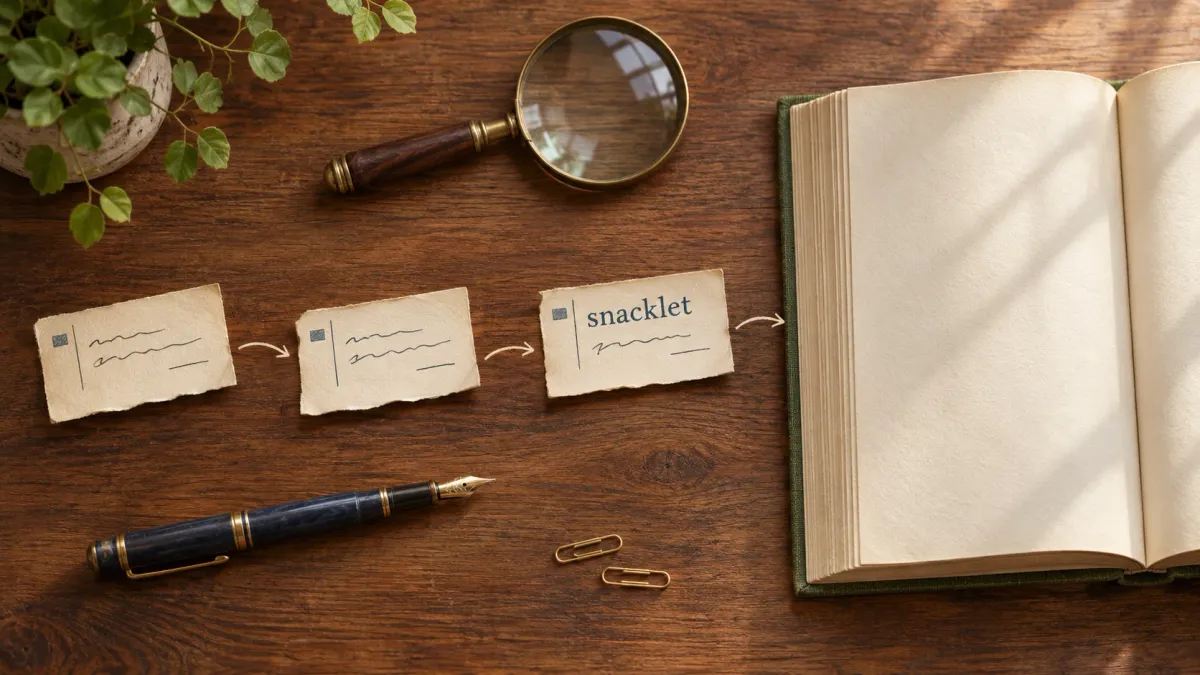
Imagine that a child calls the tiny piece left after breaking a cracker a snacklet. One family may understand the joke immediately. That makes snacklet meaningful in that room, but it does not show that the word has spread.
Now imagine other people begin using the same word without hearing it from that child. It appears in a magazine, a novel, and an online article. In each place, the surrounding sentence points to the same meaning: a very small snack or piece of one.
The word now has a public trail. Editors did not create that trail. Speakers and writers did.
Dictionary.com describes this work plainly: lexicographers find words, research their use, and record them. Its editors follow a descriptive approach, which means they study language as people use it rather than deciding in advance what people ought to say.
Editors watch usage
Merriam-Webster calls part of its process “reading and marking.” Editors read across books, newspapers, magazines, and electronic publications. When they notice a new word, a new meaning, or another useful change, they save the passage around it.
The surrounding words matter. A sentence can reveal whether a word names a thing, describes an action, or carries a special tone. A bare list of the same word repeated many times may tell an editor very little about what it means.
Modern dictionaries also use searchable collections of language, often called corpora. The tools may change, but the central question stays the same: what does the evidence show people doing with this word?
What a citation holds
In lexicography, a citation is not a school-style quotation pasted beneath a claim. It is a record of a word used in context. Merriam-Webster says its citations include the word, an example that shows the word in use, and information about the source.
Here are three invented citations for snacklet. They are examples for this article, not real publications:
“Mara packed two snacklets beside the apple.”
Invented family magazine example
“Only a snacklet of the oat bar remained.”
Invented novel example
“The café added bite-size snacklets for the afternoon crowd.”
Invented local news example
Together, those sentences suggest a small portion of food. They also show the word in more than one kind of source. That range is more informative than seeing the word many times in one writer’s work.
Evidence needs a pattern
One striking example can put a word on an editor’s radar. It usually cannot establish the whole case.
Merriam-Webster says a word for one of its general dictionaries needs substantial citation evidence from a range of publications over time. A pile of examples from a single source, or only from a narrow specialist field, may not be enough for a general dictionary. There is no universal public number that guarantees entry, and a fast-moving word may establish itself more quickly than most.
This is one place where uncertainty matters. Publishers have their own evidence, audiences, space limits, and editorial schedules. The public descriptions cited here explain broad principles, not a shared formula that every dictionary follows.
Editors shape an entry
When the evidence is strong enough for a particular dictionary, editors compare the citations closely. They work out which meanings are established, how those meanings relate to one another, and which examples make the usage clear. They may record pronunciation, spelling variants, word history, or labels that show where and how a term is used.
Then comes the deceptively hard part: writing a definition that fits the evidence. A good definition should cover the uses the editors have found without claiming more than those examples support.
The work can also change an existing entry. Oxford Languages says its annual updates include new headwords, definitions, phrases, senses, and global varieties, along with revisions and corrections based on evidence gathered by lexicographers. A familiar word may acquire a new recorded meaning even when the headword itself is old.
Different dictionaries differ
A word can appear in one dictionary and not another without either book making a mistake. A large historical dictionary, a compact school dictionary, and a specialist science dictionary are built for different readers. They do not have the same space or the same purpose.
Timing differs too. One editorial team may have enough evidence to add a word while another is still watching it. An online dictionary can update on a different schedule from a printed edition. A term common in one country or community may be rare in the sources another dictionary tracks.
This is why “Is it in the dictionary?” has more than one possible answer. The next useful question is, “Which dictionary, for which readers, and when?”
What “real” can mean
A word does not wait inside a dictionary to receive permission to exist. If people use it and understand one another, it is already doing the work of language. A dictionary entry shows that an editorial team found enough evidence to record that use for a particular reference work.
Our imagined snacklet may never travel beyond one breakfast table. It might spread for a month and disappear. Or it could turn up across many sources for years. Editors cannot know the ending from the first playful use. They can only keep following the evidence.
That is the quiet surprise inside a dictionary: every new entry begins outside the book.
To see where ReadPals begins with a new reader, visit the first reading lesson.
Sources
- How does a word get into a Merriam-Webster dictionary?
- How Does a Word Get Into the Dictionary?
- Annual updates, Oxford Languages