
Why Are They Called Lowercase Letters?
Uppercase and lowercase began as real places in a printer's workshop. See how handwriting, metal type, and wooden cases shaped the names we use.
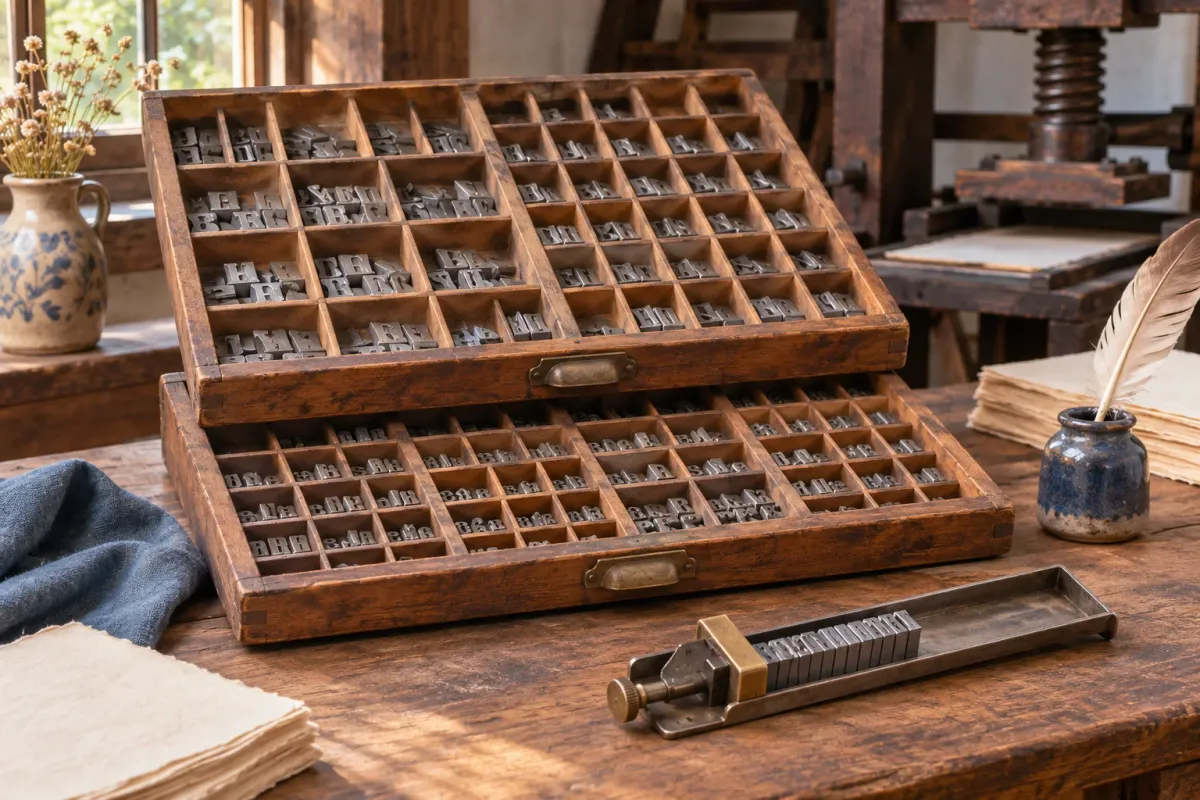
Open a keyboard and the words uppercase and lowercase seem completely digital. A tap on the Shift key changes a to A. Nothing actually moves up or down.
The names make more sense in a printer's workshop. For centuries, printers kept small pieces of metal type in shallow wooden trays called cases. Capital letters were commonly stored in a case above the one holding the smaller letters. One set was literally in the upper case. The other was in the lower case.
The names survived long after the cases left most workshops.
Before the cases
Printers did not invent the two shapes of the alphabet. They inherited them from a much older history of handwriting.
Roman monumental capitals gave readers strong, formal letter shapes. Centuries later, scribes developed rounder and more compact forms that could be written efficiently across a page. During the Carolingian period, a clear script called Carolingian minuscule helped make copied texts easier to read. The Metropolitan Museum of Art describes it as a legible script based on Roman letter forms. Letterform Archive traces the eventual introduction of lowercase forms to this Carolingian hand.
Those handwritten forms helped shape the letters printers later cut into metal. The two alphabets were already related, but they were not twins. That is why C and c look closely connected, while G and g can look like distant cousins.
A case of letters
In hand typesetting, every letter was a separate object. A compositor selected one metal sort at a time, placed the pieces into a composing stick, and built a line of type by hand.
Fast work depended on knowing exactly where each piece lived. Type cases divided the alphabet into many small compartments. Frequently used letters needed to be easy to reach. Capitals and small letters occupied separate cases, with the capital case generally positioned above the other one. The University and College Designers Association notes that these physical cases were essential to printers for hundreds of years and gave us the terms uppercase and lowercase.
The layout was practical, not a lesson about importance. Lowercase letters do most of the work in an ordinary English paragraph, so printers needed plenty of them close at hand.
The names stayed
Printing methods changed, and people began using typewriters and, later, computers to write. The wooden cases stopped being part of most writing desks, but their names had already become useful.
Today, capital letter and uppercase letter usually point to the same form. Small letter and lowercase letter do too. The case names carry a little piece of the print shop into every password box, font menu, and keyboard shortcut.
The next time a child asks why a lowercase letter is not lower on the page, the honest answer is pleasantly concrete: it used to live in a lower drawer.