
A Phonics Movement Game for Kindergarten Readers
Print six action cards. Read a word made from taught sounds, try a small movement, then draw a movement mark for the next round.
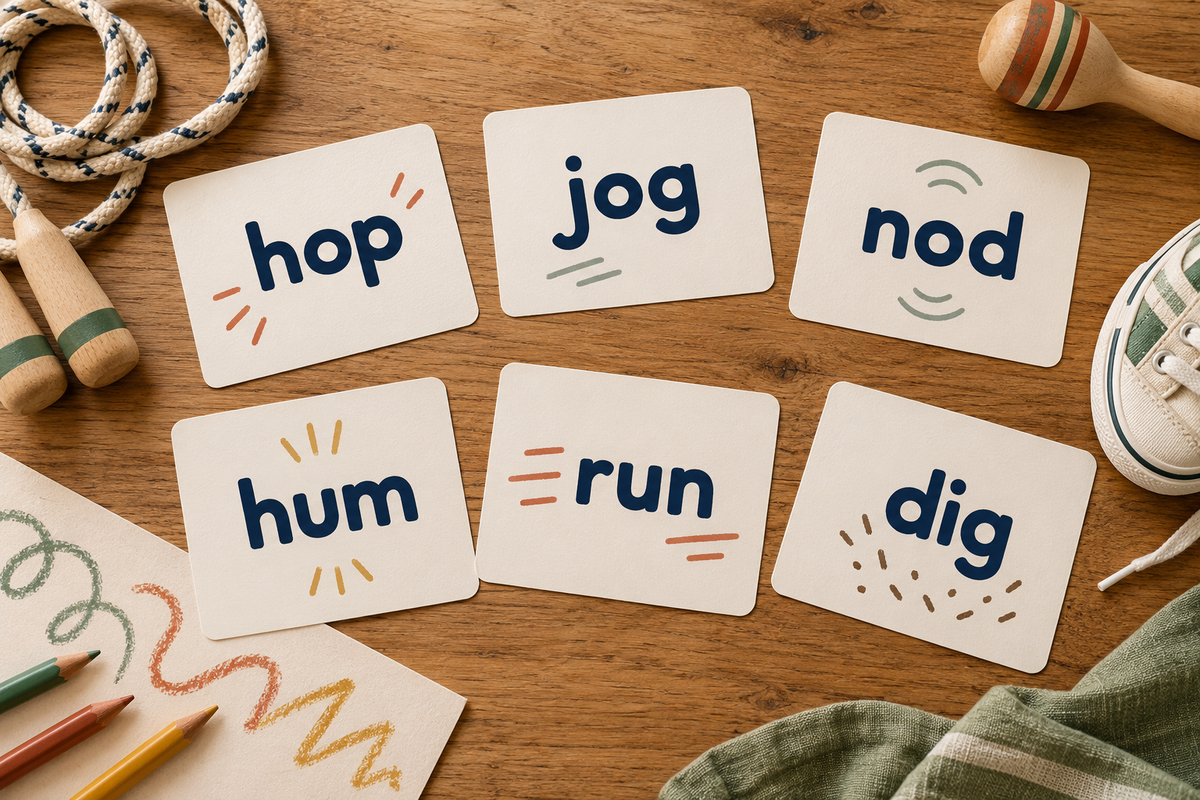
Your kindergartner can sound out a few familiar three-letter words, but after school they want to move rather than sit with another worksheet. Give them a word that tells them what to do: read hop, then make one small hop. This printable game lets your child read a word, act on its meaning and make a card of their own.
Quick answer: Print the six action cards. Choose two or three words made from sounds your child has already learned. Read each card before acting it out, then let your child draw a movement mark on it. One short round is enough.
Choose familiar words
This game is for a child who is already blending familiar short-vowel words, with help when needed. The cards say hop, jog, nod, hum, run and dig. Each is a three-sound word with a short vowel. Because the set uses several vowels, your child does not need to use all six cards today.
Ask the teacher which spellings are ready for practice. If your child has learned short o, h, p, j and g, begin with hop and jog. Add nod only if n and d are familiar too. Two cards are a useful starting set.
If your child is still learning individual letter sounds, save the reading game for later. You can point to the h in hop, say /h/ together and enjoy one hop without asking them to read the whole word. If your child already reads short sentences, let them use a card to give you the instruction.
Say the words yourself before playing. Make sure your child knows what each movement means. You can explain jog as a gentle run in place and dig as pretending to scoop with a shovel. That conversation gives the words meaning; it does not replace reading the card.
PRINT • CUT • KEEP
Your action cards
Six action cards to read before moving. Draw a personal movement mark on each card.
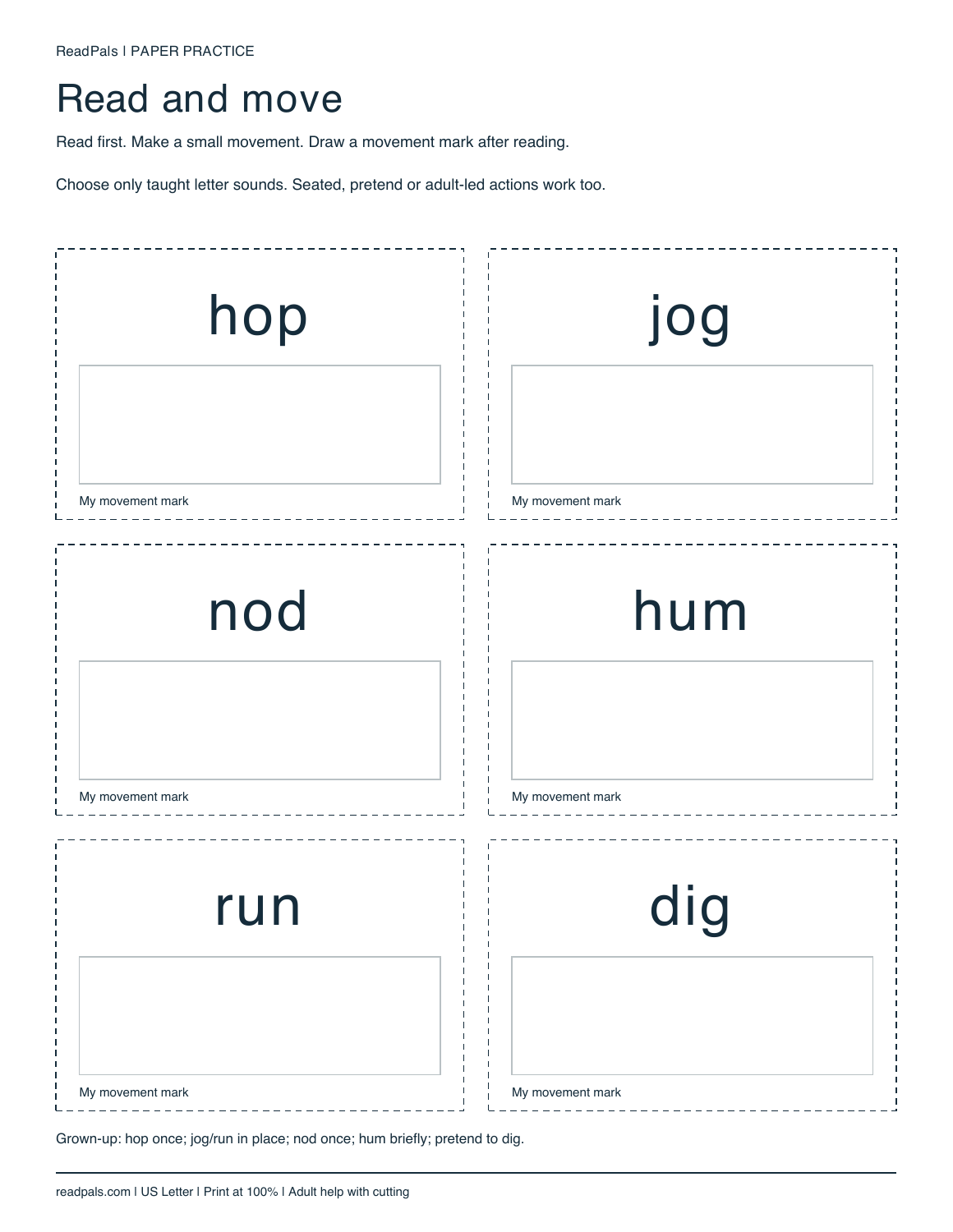
Print at 100% on US Letter paper. An adult handles cutting and any staples. No signup required.
Make room to move
You need the printed sheet, crayons and a clear patch of floor. An adult cuts the cards along their borders. Keep the cards you are not using out of sight. Three readable choices are easier to manage than a whole new stack.
Agree on small movements: one hop, a few gentle jogging steps in place, one nod, a short hum, running in place or pretending to dig. Skip any action that does not suit your child or the space. Nobody needs to travel across the room.
A child can stay seated and direct an adult, move a toy, describe the action or make a small version of it. Keep the same reading turn whichever response they choose. Physical speed or size is not part of the game.
Reveal the action
- Turn over one card. Ask, “What does this word tell us to do?” Keep your body still so your movement does not give away the word.
- Read before acting. Use your child's usual reading routine. For general help, the blending guide shows the steps.
- Follow the instruction. Make the small movement, put the card in the finished pile and let your child choose the next one.
Once nod has been read, ask, “Who should follow this card?” Your child can direct you, a toy or themselves. If they direct you, let them decide whether your action matches the word. The reader gets to use the instruction for a real purpose.
Keep the card face up during the movement. If you pick it up again, treat it as the same instruction rather than asking for a new performance. Your child can point to the word and decide whether to repeat it, make a movement mark or move it to the finished pile.
Leave a movement mark
Each card has a blank frame under the word. After reading, your child can draw a line that reminds them of the action: a bounce for hop, a wavy trail for jog or a little down-and-up mark for nod. They choose the mark; there is no model to copy correctly.
On the next round, cover the drawing with a scrap of paper until the word is read. Then reveal the mark and do the action. The drawing makes the card theirs, while the covered turn keeps attention on the letters.
If drawing interrupts the game, save it for the end. One card with one personal mark is enough to make something worth keeping. An adult can write a small date on the back if your child wants to show their teacher what they played.
Keep actions comfortable
If a movement is uncomfortable or there is little space, agree on a pretend or seated version before the round. A finger can hop across the table. A toy can do the running. The card's meaning stays the same even when the action changes to fit your child.
If the excitement takes over, put one card on the table and keep the rest out of sight. Let your child choose who acts, then finish that card before offering another. You can end with a drawing instead of another movement.
If a card does not match current lessons, take it out of this set. Use the familiar cards rather than teaching several new spellings to keep the game going. Save the unused cards in the envelope for a later round, with a note about which ones your child wants to try next.
Give the reader control
Once the three cards feel comfortable, change roles. Your child chooses and reads a card to direct you. Follow the word, even when it means making a very small pretend digging motion beside the couch. That change of roles gives the same print a fresh purpose.
Finish after the small set. Another day you can replace one familiar card with one new taught-pattern word from the sheet. You do not need to use all six, keep a score or increase the pace.
Try tonight: Cut out two or three familiar action words. Read each before moving. Let your child direct your last turn, then draw one movement mark and stop.
ReadPals has short phonics games for another practice option. This paper game works on its own, with no account or screen.